A Wall Can Hold a Little Wilderness
Vertical gardening is not a trendy luxury reserved for five-star hotel atriums. It is a fundamental engineering response to the space famine of modern towns. When you unlock your vertical boundary walls, you gain cubic meters of photosynthetic biomass without surrendering floor space.
The Mechanics: Airflow, Weight, and Drainage
Most vertical wall attempts fail within four months due to one of three mechanical errors: anchoring moisture directly onto unprotected brickwork, drastically underestimating saturated soil weight, or using sealed pockets that turn root zones anaerobic.
A safe, durable living wall functions as an independent, breathing assembly. It maintains a 50mm air cavity behind its structural backboard, drains gravity runoff predictably, and uses an open, porous planting aggregate that refuses to compact under water pressure.
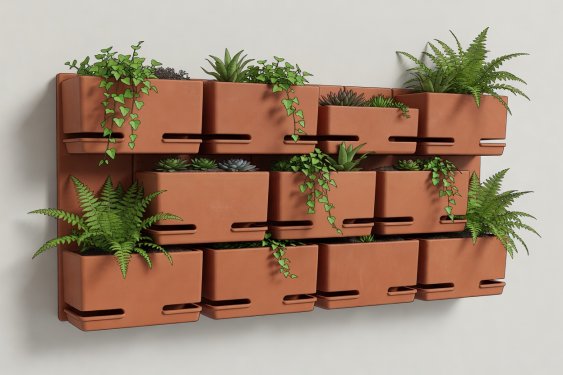
[Illustration render] Interlocking modular cassettes with rear ventilation rail.
Cascading Gravity Troughs
Interlocking injection-molded cassettes attached to horizontal aluminum batten rails. Surplus moisture from the highest row trickles down internal weep spouts into the units below, creating a self-balancing moisture gradient.
- Weight Loaded: ~28 kg per square meter (water-saturated).
- Best For: Compact salad greens, trailing strawberries, alpine campanula.
- Lifespan: 8–12 years when UV-stabilized.
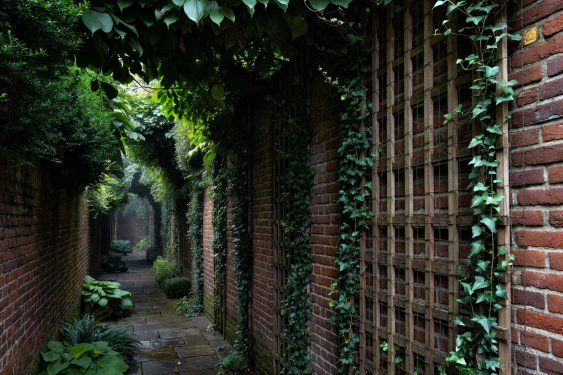
[Documented result] Marine grade 316 stainless cable standoffs keeping foliage 50mm away from brick.
High-Tensile Wire Standoffs
Instead of heavy soil modules mounted aloft, heavy root balls remain anchored in ground-level beds or large bottom troughs. Lightweight marine wire guides aerial vines skyward without loading brick facades with excess dead weight.
- Weight Loaded: Negligible wall strain (< 3 kg/m²).
- Best For: Runner beans, hops (Humulus lupulus), evergreen honeysuckle.
- Lifespan: 25+ years with zero rust.
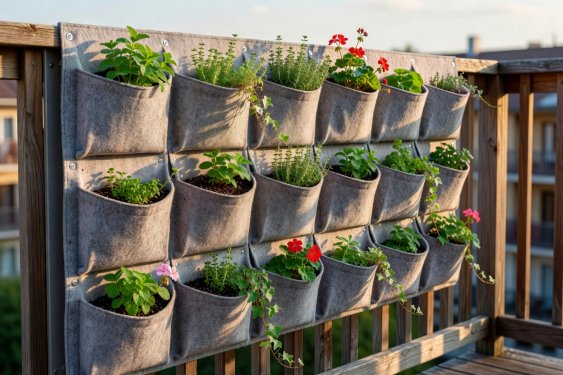
[Documented result] Recycled synthetic felt panel naturally aerating root cones.
Breathable Geotextile Pockets
Fabric pouches stitched from recycled polymers allow air circulation directly into the root mass. The phenomenon known as "air pruning" halts roots from circling the container edge, encouraging continuous fibrous hair growth.
- Weight Loaded: ~16 kg per square meter (moderate).
- Best For: Culinary herbs, wild strawberries, creeping thyme.
- Maintenance: Requires more frequent watering or automated drip line.
Never mount moisture-holding planter boxes directly flush against bare residential brickwork. Always anchor a 20mm marine plywood backer board or composite battens first, sealing the wall with a damp-proof membrane to prevent capillary moisture seepage into interior drywall.
Calculating Your Vertical Load Budget
| Mounting Surface | Permissible Safe Load | Fastener Requirement | Recommended Vertical System |
|---|---|---|---|
| Solid Victorian Engineering Brick | Up to 45 kg / m² | 8mm nylon wall plugs with stainless hex screws | Full modular rigid trough systems or heavy timber trellises |
| Modern Hollow Cavity Block | Up to 25 kg / m² | Chemical resin anchors or metal cavity toggle bolts | Lightweight felt pocket arrays or tensioned wire grids |
| Lap-Panel Timber Fence | Up to 10 kg / m² (posts only) | Galvanized wood coach screws direct into 4×4 posts | Ground-rooted climber cables attached to upright posts only |
| Rental Balcony Steel Railing | Up to 15 kg per linear meter | Heavy-duty UV-stabilized rubber-lined pipe clamps | Inward-facing hanging herb troughs resting on deck decking |